Early on in the film
Seven, the genre of the film is revealed to be a thriller. This is suggested by eratic titles and how they quickly flicker in and out. The use of the metronome causes tension because it appears to be timing or counting down to something. The opening also gets the audiece wandering who the mystery man is as he appears tho be metodical and profesional thus giving the audinence questions next is the grim images he appears to be sowing in to his book thus giving the audience the idea that he is the villan and desturbed.
Wednesday, 26 September 2012

Thursday, 20 September 2012
first filming attempt
our groups first attempt at filming was unsuccessful as our inexperience and lack of focus meant we had to redo every shot 2-5 times. we had issues deciding upon the opening shot but we eventually decided how to film it and how
we wanted it to look. a group member made an error that none of us noticed until the
editing stage which taught us to check each shot before moving on.the schools editing software was enjoyable to use.
Wednesday, 19 September 2012
Camera Angles
Close-up; this type of shot shows an enlarged view of part of an object or person. This shot is used as it draws attention to important objects or people and adds emotion.
medium shot; shows a normal size view of an object or person like someone would expect to see using their own eyes. this focuses the audiences attention to details
Shot/ reverse shot
Match on Action
match on action is a video editing technique where the editor cuts from one shot to another view that matches the first shot's action.
Although there may be a noticeable time differance between whhen the two shots were filmed, cutting on action gives the impression of continuous time
when watching the edited film. By having a subject begin an action in
one shot and carry it through to completion in the next, the editor
creates a visual bridge, which distracts the viewer from noticing the
cut or noticing any slight continuity error between the two shots
Thursday, 13 September 2012
180-degree rule
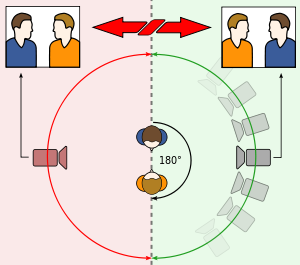 180-degree rule
this rule will aid the viewer as it gives an coheriant undestanding of the conversation .
definition
A rule
stating that a camera should be placed somewhere inside 180 degrees on a
particular side of the invisible line
of a shot
containing two people filmed in sequence. If the camera crosses the line,
confusion results for the film
viewers, because it makes it look like the people are switching places as one
watches the film.
continuity
continuity
In fiction, continuity (also called time-scheme) is consistency of the characteristics of persons, plot, objects, and places seen by the reader or viewer over some period of time. It is of relevance to several media.
this was taken from wikipidea
in general continuity is easy to use as all it requires the director to to keep charicters and actions between sceenes the same in apperiance.
this is an over the top example of bad continuity
me, myself and I
hello there
im am a 17 year old, studying at kscs, also I run an ambigram business
from
Scott marriott
im am a 17 year old, studying at kscs, also I run an ambigram business
from
Scott marriott
Subscribe to:
Posts (Atom)